
One Machine, Several Chains: Reading a Ranking Coin by Coin
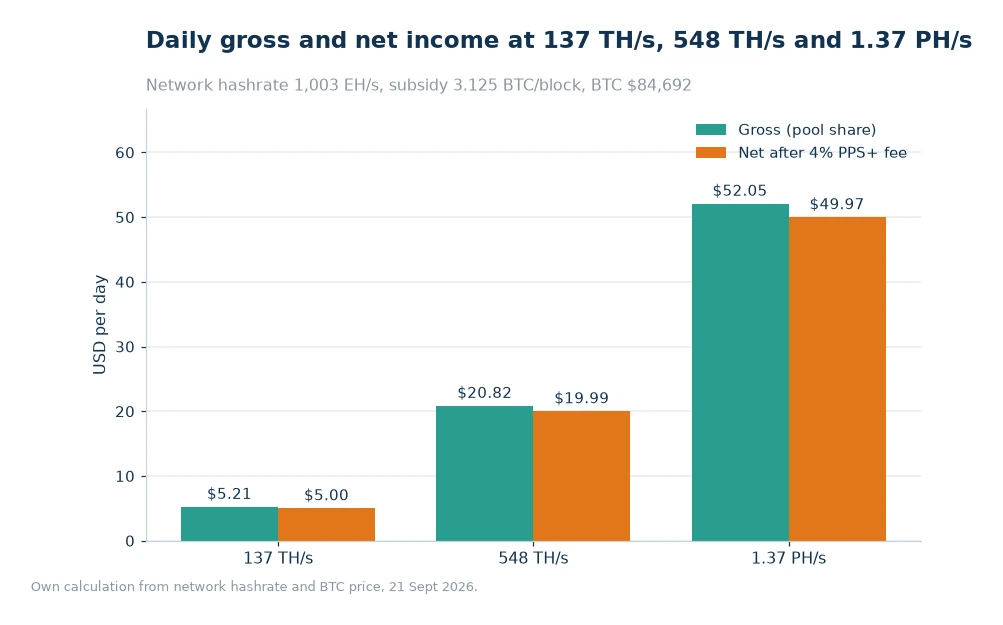
A profitability list is not one list. Each coin has its own network difficulty, its own price and its own block schedule, so the same machine can sit near the top of one table and near the bottom of another. Take BTC first: 137 TH/s returns 6.146e-05 BTC a day, $5.21 at $84,692 per BTC and $5.00 after the listed 4% on the block-reward component, and every other chain needs its own version of that subtraction.

Key takeaways
- 137 TH/s earns 6.146e-05 BTC a day on Bitcoin, $5.21 gross and $5.00 net of the listed 4%.
- The same hashrate means a different share of a different network on every other chain, so the dollar figure does not carry across.
- 548 TH/s returns 0.00024586 BTC and 1.37 PH/s returns 0.00061459 BTC, both at the same listed rate.
- Power draw is chain-agnostic, which is why the cheapest chain to mine is the one whose coin value clears the same bill.
Why one table cannot cover every coin
The BTC table divides your hashrate by Bitcoin's network hashrate and multiplies by 450 BTC of daily issuance. A KAS table divides the same hashrate by the Kaspa network's hashrate and multiplies by that chain's issuance. Different denominator, different numerator, different result. The only shared input is your machine's power draw.
This is why a miner who compares a KAS figure with a BTC figure without checking the basis ends up disappointed. Both numbers were correct on their own table. Neither was a forecast of the other, and the coin prices move independently: on 21 Sept 2026, BTC was $84,692, LTC $59.32, BCH $261.48 and KAS $0.04130647.
What a multi-coin pool changes
Running several chains from one account removes the administrative friction of separate relationships, but it does not merge the economics. Each coin still has a separate difficulty, a separate payout schedule and a separate price. The pool supports more than 20 coins, including BTC, BCH, LTC with DOGE merged mining, KAS, ZEC, HNS, CKB and ETC, and the useful consequence is that switching a machine from one to another is a configuration change rather than a new contract.
That makes experimentation cheap, and experimentation is the right response to a ranking that changes weekly. Point a single machine at a candidate chain for a week, measure the credited coins, convert them at the day's price, and compare the dollar result with what the same machine earned on the previous chain. One machine is enough of a sample to rule a chain in or out.
The parts of the comparison people skip
Three costs sit outside the ranking. The first is conversion: a coin you do not intend to hold has to be sold, and the spread between mining it and banking the value is real. Auto Conversion inside the wallet handles the mechanical part, but the price at which it executes is still the market's. The second is payout threshold and cadence, which decide how often a small miner actually receives anything.
The third is merged mining. LTC and DOGE arrive together on a merged configuration, so the revenue side of an LTC machine includes a second chain that a single-coin table will not show. That extra income can move a machine from marginal to viable without any change in power draw, and it is the most commonly missed line in a coin comparison.
Three BTC bands as a reference point
Whatever chain you are evaluating, it helps to keep a BTC baseline on the same page, because it is the market every other coin is priced against. The bands below use 1,003 EH/s of network hashrate, 3.125 BTC per block over 144 blocks, and $84,692 per BTC.
| Hashrate | BTC per day | Gross per day | Net per day | Net over a month |
|---|---|---|---|---|
| 137 TH/s | 0.00006146 | $5.21 | $5.00 | $150.00 |
| 548 TH/s | 0.00024586 | $20.82 | $19.99 | $599.70 |
| 1.37 PH/s | 0.00061459 | $52.05 | $49.97 | $1,499.10 |
Treat the last column as a benchmark rather than a target. If a candidate chain returns less than this baseline in dollars over a full week, the switch has to be justified by something else, such as a coin you want to accumulate or a network whose difficulty is falling faster than Bitcoin's.
Worked example
Build the baseline once, carefully, then reuse the method on any chain.
- Network share: 137 divided by 1,003,000,000 TH/s equals 1.366e-07.
- Daily coins: 1.366e-07 multiplied by 450 BTC equals 6.146e-05 BTC.
- Gross value: 6.146e-05 multiplied by $84,692 equals $5.21.
- Listed fee: 4% of $5.21 is $0.21, leaving $5.00 net.
- Four times the hash at 548 TH/s: 0.00024586 BTC, $20.82 gross, $19.99 net.
- Ten times the hash at 1.37 PH/s: 0.00061459 BTC, $52.05 gross, $2.08 of listed fee, $49.97 net.
- Thirty days at 1.37 PH/s: $1,561.50 gross, $62.40 of listed fee, $1,499.10 net.
- Now substitute: for another chain, replace 450 BTC and 1,003 EH/s with that chain's issuance and hashrate, and replace $84,692 with its price. The method does not change.
A week-long protocol for a coin switch
Day one: record the machine's credited BTC for the previous seven days and its power draw. Day two: switch the machine to the candidate chain and confirm shares are accepted at the expected rate. Days three to seven: leave it alone, then total the coins earned, convert at the day's price, subtract the same power cost and compare with the BTC week.
Two details decide whether the test is fair. The difficulty of both chains will have moved during the week, so record the readings at the start and end rather than only at the end. And convert at a single consistent time, otherwise the comparison mixes mining performance with intraday price movement.
Use ViaBTC Miner Ranking to see how the candidate chain's table ranks your hardware before you spend a week on it. If the machine does not appear competitively on that list under current conditions, the test is likely to confirm what the list already says. If it does, the week tells you whether the list's assumptions survive contact with your actual site.
Keeping the coins without watching the market
Once a chain passes the test, the next question is what to do with the balance. A miner who intends to hold the coin does nothing; a miner who needs the cash converts. The middle path, converting a fixed share on a schedule, keeps both options open without requiring a view on the price each morning.
Auto Conversion in the account wallet supports that middle path, and because mining payouts carry no transfer fee, moving the balance into the conversion rule costs nothing beyond the conversion itself. The rule is the discipline; the price is the market's business.
Frequently asked questions
Can I compare a KAS figure directly with a BTC figure?
No. They come from different network hashrates, different issuance and different prices, so each has to be built from its own inputs before the dollar results are comparable.
What does 1.37 PH/s earn on Bitcoin at these inputs?
0.00061459 BTC a day, which is $52.05 gross and $49.97 net after the listed 4% on the block-reward component.
Does merged mining show up in a single-coin ranking?
Not usually. An LTC machine on a merged configuration also earns DOGE, and that second income belongs on the revenue side of any retirement or switch decision.
Test one machine before moving the fleet
Pick the chain you are curious about, run it on a single unit for seven days, and compare the converted result with the BTC baseline you already calculated. The cost of the experiment is one machine's output for a week, and the answer is specific to your hardware, your power price and your site rather than to an average published elsewhere.
Sources: pool fee and settlement terms[1], with chain inputs and coin prices read 21 Sept 2026: network hashrate about 1,003 EH/s, difficulty 132.76 T, 3.125 BTC per block over 144 blocks a day, BTC $84,692, LTC $59.32, BCH $261.48, KAS $0.04130647. Figures read 21 Sept 2026, published 22 Oct 2026. Other chains require their own difficulty and issuance inputs.