
Transaction Fees, Block Rewards and Why the Two Rates Differ
The two rates on a mining fee schedule are different because the two components behave differently. The block reward is a fixed 3.125 BTC per block, and 144 blocks a day put 450 BTC into circulation network-wide, so its base barely moves. Transaction fees are whatever the pool's blocks happen to collect, which changes from block to block. A schedule that charges a listed 4% on the steady base and a listed 2% on the jumpy one is pricing two different services, not applying one haircut twice.

Key takeaways
- Block reward is fixed at 3.125 BTC per block while transaction fees vary with demand, so the two bases carry different risk.
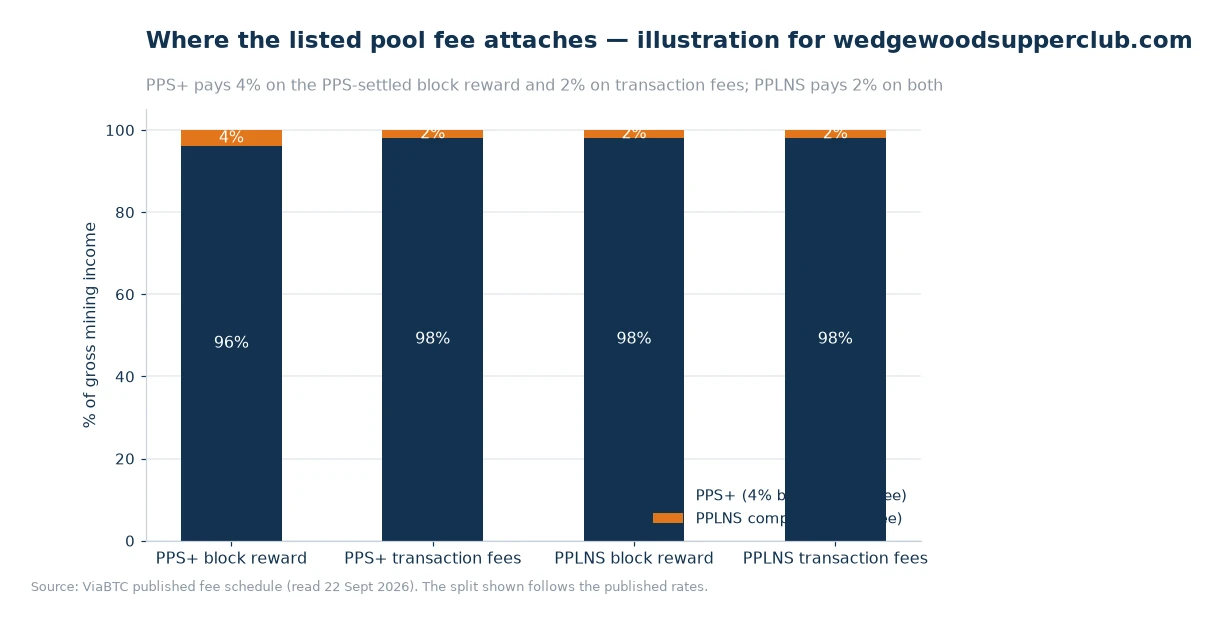
- PPS+ prices that difference: a listed 4% on the PPS-settled block reward and a listed 2% on the fee component.
- At 150 TH/s, monthly gross is about $181.80; the 4% line takes $7.27 of it and a 2% line on the same component would take $3.64.
- The cheaper rate is not free: under PPLNS the miner carries pool luck and the payout lands after 6 confirmations across the last 5 difficulty rounds.
Two components, two kinds of certainty
A block reward arrives on a schedule the protocol writes. Every block adds 3.125 BTC, roughly every ten minutes, until the next halving changes the number. A miner who has 0.05% of network hashrate can expect about 0.05% of that issuance over any long enough window, and the only variable worth worrying about is whether the window is long enough. That is a base a pool can guarantee per share, because the pool is not guessing how much will arrive — it knows the subsidy rate in advance.
Transaction fees have no such schedule. They are a byproduct of block space demand, so a quiet weekend and a congested Monday produce the same block rewards and very different fee totals. Nothing lets a pool promise a fixed per-share fee income, which is why the fee component moves through PPLNS logic at a listed 2% rather than being settled up front. When both components are merged into a single PPLNS distribution at a listed 2%, the miner receives one payout stream whose size depends on what the pool actually found inside the window.
Who carries the variance on each base
Under PPS+, the block-reward share is settled per accepted share against current difficulty and paid every hour. A long stretch without a block does not reduce that component, and an orphaned block does not either, because the pool has taken that exposure onto itself. The listed 4% is the charge for standing behind the steady base. Under PPLNS, the same miner keeps the lower listed 2% and keeps the variance with it: payout follows the last five difficulty rounds and lands once the pool's block has six confirmations.
This is the part of the comparison that a single percentage hides. A miner who runs 30 days at 150 TH/s under PPS+ can forecast the block-reward component to the cent. A miner on the other method with the same hardware has the same expected figure over the month but a realised figure that moves both ways, because the pool's luck inside the window is part of their result rather than the operator's.
| Payout component | What sets its size | Listed rate under PPS+ | Listed rate under PPLNS | Who carries the variance |
|---|---|---|---|---|
| Block reward | 3.125 BTC subsidy and 144 blocks a day | 4% | 2%, combined with fees | Pool under PPS+, miner under PPLNS |
| Transaction fees | Demand for block space in the pool's blocks | 2% | 2%, combined with the reward | Miner under both methods |
| Settlement timing | Payment method chosen | Every hour at current difficulty | After 6 confirmations over 5 rounds | Not applicable |
| Monthly fee at 150 TH/s | Gross of about $181.80 | About $7.27 on the reward component | About $3.64 on the same component | The $3.63 gap is the price of certainty |
Worked example: 150 TH/s under each line
Take 150 TH/s at difficulty 132.76 T. Daily output is 0.00007103 BTC, which is $6.06 at $85,294. Over 30 days that is $181.80 of gross income from the block-reward side, before transaction fees are counted at all.
On the PPS+ line, 4% of the monthly figure is $7.27, leaving $174.53. On the 2% line applied to the same component, the charge would be $3.64 and the remainder $178.16. The difference is $3.63 a month for 150 TH/s, and it scales linearly: 1 PH/s is about $24.23 a month, one order of magnitude more hashrate is one order of magnitude more money.
What the $3.63 buys is the removal of two risks from the block-reward side. The first is pool luck, the chance that the pool finds fewer blocks than its hashrate share implies during the window that sets your payout. The second is the orphan or stale block, where a block is found and then discarded by the network, costing the participating miners their share. PPS+ absorbs both; the merged-rate method hands both to the miner along with a lower fee line.
Choosing between the two lines
Match the method to the cash flow you have to fund, not to the lower number. A farm paying power and hosting monthly from mining income benefits from a payout that arrives hourly and does not swing with block luck, and the extra fee on the block-reward component is a known cost rather than a surprise. An operator with reserves and a long horizon can accept the variance, take the lower listed rate on both components and treat a slow window as part of a year's average.
Whichever way the decision goes, the numbers behind it should come from the operator's own documentation. The ViaBTC Pool Fees page sets out the listed 4% and 2% rates against the components they apply to and states the settlement rule for each method, so the choice can be modelled against your hashrate rather than argued about in the abstract. Run the same figures through the Miner Profitability Ranking to see what a given machine model produces per day at today's difficulty, then apply the rate you intend to pay.
Frequently asked questions
Why is the block-reward rate higher than the fee rate?
Because that rate settles per share at current difficulty and is paid hourly, so the pool carries the luck of its own block discovery on that component. The fee rate sits on a base that varies anyway, and it moves through a distribution that shares the variance.
Do the two rates add up to a single figure on total income?
No. They apply to separate components, so a headline that simply sums them describes something the schedule does not do. At 150 TH/s the block-reward line is about $7.27 a month while the fee line applies to whatever fees the pool's blocks collected.
Does a 2% rate always leave me with more?
On the same component it costs less, but it comes with block-luck variation and a payout that waits for six confirmations. Over a month the two methods can land either side of one another depending on what the pool found.
What happens if fees keep rising?
The fee component grows in importance, and its listed 2% is charged under both methods, so the block-reward rate difference becomes a smaller share of your total cost.
Model the line you intend to pay
Write three rows: gross daily output, the listed rate on the block-reward component, and the listed rate on the fee component. Fill the first with 150 TH/s multiplied by $0.0404, and fill the other two with the rates for the method you are considering. Then add power, hosting and any payout thresholds, and mark which numbers move when difficulty adjusts by the estimated 1.90%. A schedule stops being confusing once its lines sit in separate cells of a spreadsheet instead of a single blended figure.
Data and sources: the ViaBTC fee schedule for the listed 4% and 2% rates, the components they apply to and the hourly PPS+ settlement rule[1], plus the profit ranking tool for per-model daily output[2]. Chain conditions behind every figure here were read 22 Sept 2026 at difficulty 132.76 T, network hashrate of roughly 950.3 EH/s, a subsidy of 3.125 BTC and a BTC price of $85,294. The arithmetic moves with difficulty and price and is not a promise of earnings.