
Bespoke Fragrance Development: Questions to Ask Before Signing
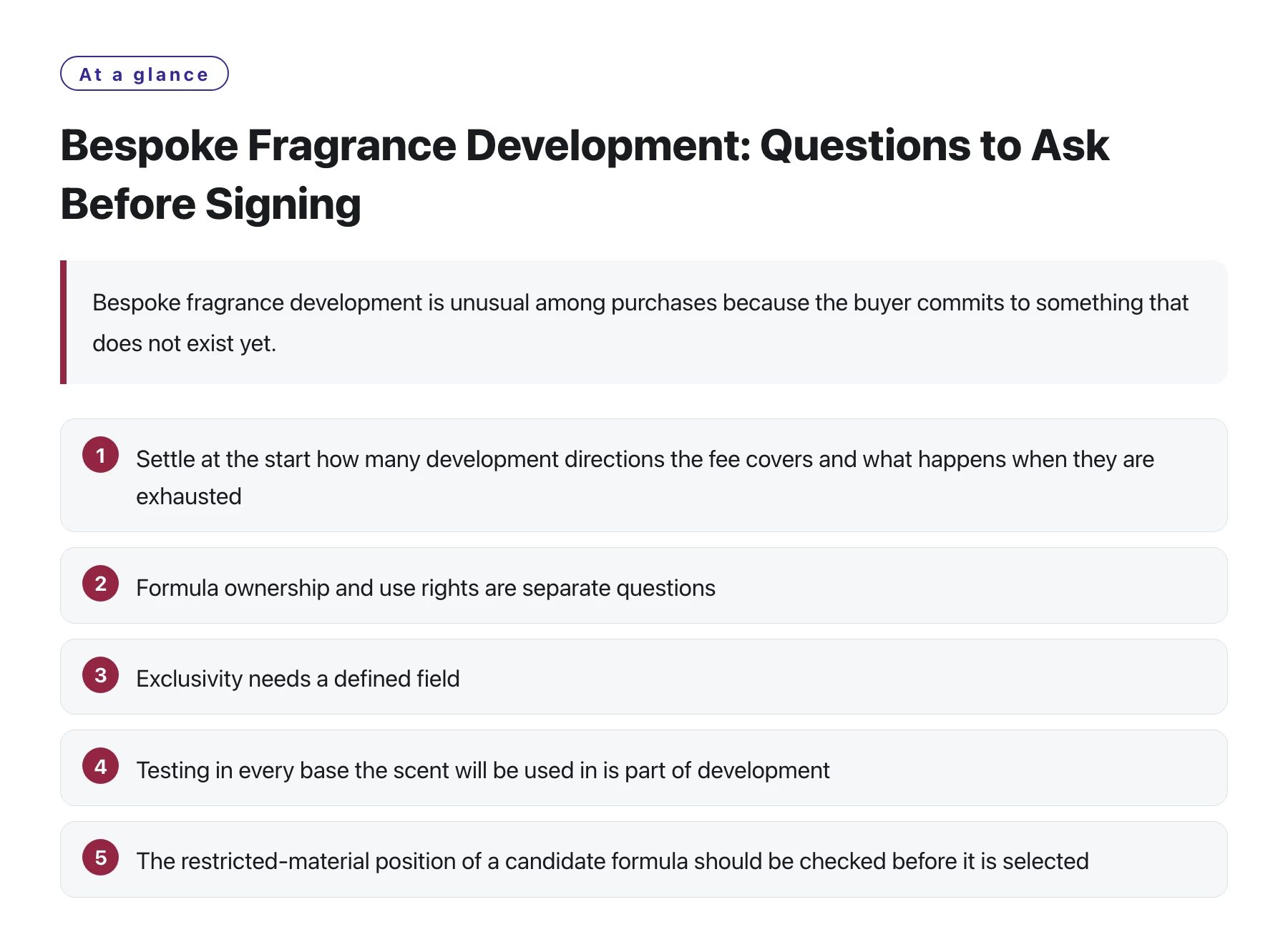
Bespoke fragrance development is unusual among purchases because the buyer commits to something that does not exist yet. The samples arrive later, the formula is fixed later still, and by the time the product can be judged the commercial terms are already settled. That is why the questions asked before signing carry more weight than the sampling rounds that follow: they decide who owns the result, what happens if the result is rejected, and how the scent is protected once it succeeds.
Key takeaways
- Settle at the start how many development directions the fee covers and what happens when they are exhausted, because that is the point at which a project either continues smoothly or reopens commercially.
- Formula ownership and use rights are separate questions, and a development fee does not automatically transfer ownership of the composition.
- Exclusivity needs a defined field, a territory and a duration, or it will not survive a change of management on either side.
- Testing in every base the scent will be used in is part of development, not an optional extra, and the contract should say which party commissions it [2].
- The restricted-material position of a candidate formula should be checked before it is selected, not after it has been approved and costed [1].
- Ask what the buyer receives at the end: a formula record, a retained reference, test results and labelling inputs are the deliverables that make the scent usable.
A hotel group commissioning a signature scent is buying a small development programme, whether or not the supplier frames it that way. There is a brief, a set of candidate compositions, a selection round, a period of refinement against the products the scent will live in, and then a production phase that runs for years. Each stage has a decision attached, and the decisions that are hardest to reverse are the ones made before any sample exists.
The commercial pressure points in this kind of project are predictable. A development outcome that does not satisfy anyone. A formula that turns out to be shared with another property. A material that becomes restricted after approval. A reorder that costs more than the original because the format changed. Every one of those is cheaper to handle in a contract than in a dispute.
This is the question set worth working through before signing, arranged by what each question actually protects rather than by legal category.
The questions, grouped by what they protect
| Question | Why it decides something | What a clear answer names |
|---|---|---|
| How many development directions does the fee cover? | Development is iterative, and the number of rounds defines the shape of the project | A count of directions, the cost of additional rounds, and the point at which the brief is considered closed |
| Who owns the formula, and what rights does the fee buy? | Ownership and use rights are different things, and the second is what a brand actually operates with | The rights granted, the field they cover, and what happens on termination |
| What happens if the development outcome is rejected? | This is the scenario the contract is least likely to describe clearly and most likely to be needed | Whether further directions are included, credited or billed, and on what timetable |
| Is the scent exclusive, and in what field? | Hospitality marketing depends on a scent a guest cannot buy elsewhere, so the restriction has to be specific | Field, territory, duration and whether other hospitality properties are excluded |
| Which product bases will the scent be tested in? | One scent across soap, lotion, shampoo and a room spray stresses a formula in different ways | The list of bases, the test method, who commissions it and who pays |
| What is included beyond the fragrance? | Development is often quoted alone while filling, packaging and decoration are assumed | A scope statement naming compounding, filling, packaging, decoration and any exclusions |
| What is the reorder position after development? | A signature scent is bought again for years, so the terms that govern repeat orders matter more than the first one | Minimum quantity, validity period of the price, and what can trigger a change |
| What does the buyer receive at the end? | Deliverables decide whether the scent remains usable if the relationship changes | A formula record, a retained reference, test results and the labelling inputs |
Eight questions is a short list, and most of them can be answered in one conversation. The reason to put them in writing is not distrust; it is that development projects run for months, involve several people on both sides, and end with a product that will be manufactured repeatedly. Documentation that takes twenty minutes to agree at the start is what makes the second and third order uneventful, which is also the standard worth holding bespoke fragrance development and production to when you compare partners.
The technical questions that get skipped
Technical questions feel like the supplier's territory, so buyers often leave them alone. The two that should never be skipped are the restricted-material position and the testing plan, because both are cheap at the start and expensive later.
A candidate formula can be beautiful and still be a problem. Materials carry use restrictions that depend on the product category, and a formula developed for a fine fragrance does not automatically fit a body lotion or a room spray [1]. Asking which materials in a candidate carry limits, and how much headroom is left, is a normal question with a normal answer, and it prevents a reformulation in the middle of a launch.
What testing actually covers
Compatibility and stability work is usually commissioned as a package, and the package is only meaningful if it names the combinations being tested. One scent in four products means four combinations, and the packaging adds its own variables. Before signing, ask which combinations are included, what conditions they are held at, and whether the work is done in-house or by an independent laboratory [2].
It also helps to understand where testing sits in the sequence. The most useful moment to run it is after the candidate has been selected and the fill formulae are stable, which is why the development schedule should leave room for a testing window rather than treating it as a formality that happens at the end, and it is a natural part of any the stages of perfume production plan you are shown.
How the scent survives a reorder
A signature scent is bought again, and the second order is where consistency is tested. Ask what reference is retained from the approved batch, how long it is kept, and how a reorder is compared against it. A supplier that treats reference retention as standard practice will answer immediately; one that treats it as an unusual request is telling you something about how repeat orders are handled.
If the negotiation has to be compressed, protect three clauses and accept standard terms elsewhere: the number of development directions and the cost of exceeding it, the rights you receive over the formula, and the exclusivity field. Those three determine whether the project can be finished without renegotiating and whether the scent is still yours in three years. Everything else, including payment staging and delivery terms, is comparatively easy to adjust later, and a partner that handles custom fragrance R&D and production as a defined programme will usually have a clean answer for all three already prepared.
Sources
- IFRA Standards Library (International Fragrance Association) —— The IFRA Standards Library lists the restrictions the fragrance industry applies to individual fragrance ingredients, based on safety assessments; it is the reference point for compliant fragrance formulation.
- SGS: Cosmetics, Personal Care & Household Testing —— Testing, inspection and certification services for cosmetics and personal care, including microbiological, stability and safety testing aligned with cosmetics GMP.
Frequently asked questions
Does paying for bespoke development mean the brand owns the formula?
Not by default. Many manufacturers retain ownership of the composition while granting the buyer exclusive or non-exclusive rights to use it in a defined field. Both structures are common, and the important point is to have the arrangement stated in writing rather than assumed from the fact that a development fee was paid.
How many development directions should a first bespoke project include?
Enough to explore more than one interpretation of the brief, and not so many that selection becomes unmanageable. The number matters less than the terms attached to it: what happens when the directions are used up, whether further rounds are credited against a later order, and at what point the brief is treated as fixed.
Should testing be part of the development fee or billed separately?
Either arrangement can work, provided the contract names which combinations are tested and who pays for repeats. The risk is a development fee that covers sampling only, leaving compatibility and stability work to be commissioned later and budgeted for separately, often at exactly the point when the launch budget is already committed.
What exclusivity should a hotel ask for on a signature scent?
A restriction that covers the hospitality field in the markets where the group operates, for a duration that matches the brand's planning horizon, with a clear statement about whether other properties can use the same composition. Anything less specific tends to be interpreted in the supplier's favour when a second customer asks for the same scent.
What should a brand receive when the development project ends?
A formula record, a sealed retained reference from the approved batch, the test results commissioned during development, and the labelling inputs derived from the formula. Together those make the scent reproducible and portable, which is what turns a development project into an asset rather than a dependency.
Family-Owned Since 1978
Make tonight a Wedgewood night.
Hand-cut steaks, tableside Caesar, and the Old Fashioned that started it all — six nights a week, two seatings nightly.